Background:
Corn rootworm populations have risen rapidly over the past 5 years due to many different factors. Climate, agricultural practices, and the insects’ ability to adapt and overcome have changed the ways these pests need to be managed.
Causes of rising populations:
- BT resistance: As rootworms become resistant, Bt toxins become less effective at controlling them, leading to increased root damage, lodging and, ultimately, substantial yield reductions.
- When corn rootworms are repeatedly exposed to the same Bt trait year after year (especially in corn-on-corn fields), rootworms that carry resistance genes are more likely to survive and reproduce. As susceptible bugs are killed off over time, more of the population becomes resistant as survivors pass on their resistant traits. Their offspring gradually dominate. Read more about Bt resistance.
- Pesticide resistance: Repeated application of the same chemical is also a key factor. It has allowed rootworms to adapt, making them difficult to control.
- Lack of crop rotation: The lack of crop rotation has also led to major issues in management efforts. Rootworms rely on corn roots as a primary food source. Rotating with another crop removes that food source and, therefore, helps decrease populations in coming years. Soybeans do not support the pest at all, so that’s a great choice for a rotation crop to aid in pest control.
Identification:
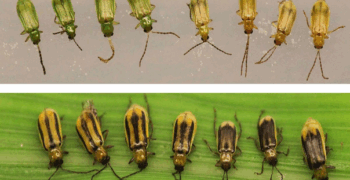
- Northern corn rootworm: Northern corn rootworm beetles are about ¼ of an inch long, with females being slightly larger than males. They are usually a light green color with no distinct markings. When they first emerge, they may be tan.
- Western corn rootworm: Western corn rootworm beetles are ¼ inch long. They are yellow with distinct black markings. On their backs, they will have three black streaks going vertical. Females have more defined black streaks while markings on males can appear more smudged together. (Corn Rootworm ISU)
- The sexes of all rootworm beetles can be determined by looking at the abdominal apex: in females it is pointed and in males it’s blunt (see image above).
Lifecycle:
The life cycle of the corn rootworm has 4 stages: egg, larva, pupa, and adult.
Both Northern and Western corn rootworms produce one generation per year, beginning as an egg that stays in the soil over the winter season. In spring, the eggs hatch, releasing the larvae, which will transition through three instars and feed on the roots of corn plants for 4 to 6 weeks. They pupate in the soil for 5 to 10 days before emerging as mature adults that feed on the plant and mate during the summer. In late summer and fall the cycle starts again. After laying eggs, the adults will continue to feed on the plants before dying after several hard frosts. (Life Cycle ISU)
Lifecycle variations:
Just like diseases, both Northern and Western corn rootworms have changed their life cycles to survive. Extended diapause is a natural but adaptable event that is influenced by climate and management practices that leads to an increase in the length of dormancy of these pests. This can affect practices like using rotational crops, leading to costly yield hits. Scouting for these pests each year is important in identifying the times when extended diapause is present in your fields to prepare for the next.
- Northern corn rootworm has adapted to crop rotation with extended diapause, which means that some of the eggs will remain dormant for 2+ winters. If corn is rotated annually with soybeans or another non-host crop, the eggs will hatch in 2 years when you plant corn again.
- Western corn rootworm has adapted to crop rotation by modifying its behaviors during oviposition. The female adults who are soybean-variants will lay eggs in both bean and corn fields. The eggs will overwinter in the soybean fields and will hatch in a cornfield in the spring.
Assessing damage:
The Nodal Root Injury Score System (NIS System), created by Iowa State University, is used to assess the damage to roots caused by corn rootworms. This system has two different scales, the Node-Injury Scale and the Traditional Scale.
The Node-Injury Scale consists of four values, all based on the node feeding:
- 0 – No feeding
- 1 – one node (circle of roots), or the equivalent, is eaten back to about 1 ½ inches of the stalk,
- 2 – two complete nodes are eaten
- 3 – three or more of the nodes are eaten (highest rating)
The Traditional Scale goes as follows:
- 1 – no damage
- 2 – feeding scars are evident, but no roots are eaten off within 1 ½ inches of the plant
- 3 – several roots are eaten off to within 1 ½ inches of the plant, but not enough to be an entire node
- 4 – one node of roots is destroyed
- 5 – two nodes are destroyed
- 6 – three or more nodes are gone
Management practices:
- Crop rotation: Rotating your crops to remove the food source for these insects is the most effective management practice. Using soybeans is a great option as a rotational crop, as it does not support the pest in any aspect. In more severe cases, consider longer crop rotations with non-host crops.
- Insecticide application: Diversifying your insecticides can help control corn rootworm beetles. Avoid using the same chemical each year, as resistance is possible.
- New Bt varieties: Using new BT varieties and trait stack technology can help manage resistance more effectively.